



The property insurance market is undergoing a tumultuous period marked by significant challenges as prominent insurance companies retreat from high-risk states. Florida’s Chief Financial Officer, Jimmy Patronis, has criticized Farmers Insurance for its lackluster communication and negotiations after the company halted policies in the hurricane-prone state. The repercussions of this retreat are rippling across the industry, leaving both companies and consumers grappling with the consequences.
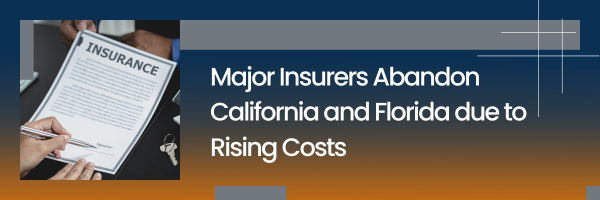
BlackRock CEO Larry Fink has raised an alarm about a less-discussed issue—major insurance companies abandoning California and Florida due to their inability to raise rates sufficiently to generate returns. Fink’s concerns emphasize the potential impact on a substantial segment of the population who may find themselves unable to afford homeowners insurance in high-risk areas.
Prominent insurance names such as State Farm, Allstate, and Farmers Insurance have all declared their refusal to underwrite new business in California. Meanwhile, seven insurance companies in Florida have faced insolvency since the start of 2022.
The Wall Street Journal recently highlighted the mounting pressure on insurers to increase premiums for auto and homeowners insurance, spurred by significant losses resulting from catastrophic events. Numerous states, including Texas, Illinois, Kentucky, Colorado, Tennessee, Arkansas, and Missouri, have each suffered damages exceeding a billion dollars due to severe weather this year alone.
This trend raises a fundamental question: Why are insurance companies retracting coverage and even exiting certain states altogether? David Sampson, CEO of the American Property Casualty Insurance Association (APCIA), sheds light on the complex dynamics at play. Sampson explains that insurers are grappling with a need to rebalance risk portfolios across the nation in response to ongoing record losses from natural disasters. Simultaneously, a range of economic and societal factors is contributing to the current challenges.
Sampson identifies several key factors exacerbating the situation. Firstly, unprecedented inflation levels have driven up the costs of covering losses. For instance, home construction materials have surged by over 35% since the onset of the pandemic, with a corresponding 30% increase in construction labor costs.
Secondly, reinsurance companies are navigating a shifting landscape due to elevated global capital costs resulting from rising interest rates. The allure of higher returns in other investment opportunities has led to tighter and more expensive global reinsurance capital, further impacting the insurance sector’s stability.
A third critical concern centers on the unchecked abuse of the legal system, which has contributed to disruptions in Florida’s insurance market. Efforts led by the GOP-led legislature and Republican Governor Ron DeSantis have aimed to address this problem through comprehensive reforms aimed at curbing lawsuit abuse.
Despite these initiatives, Florida’s recent reforms require time to take effect. In the interim, annual property insurance premiums have surged by 42%, reaching $6,000 in the state, far surpassing the national average of $1,700. Disturbingly, more than 15% of Florida homeowners lack property insurance, more than double the national average of 7%, as reported by the Insurance Information Institute.
Sampson asserts that the most significant challenge facing insurers is increasingly restrictive regulatory measures hindering their ability to manage risk and secure appropriate rates. California is singled out as a prime example of such regulatory constraints. The state’s outdated regulatory framework has forced some insurers to exit due to the unsustainable impact of the 2021 and 2022 wildfire seasons, erasing over a decade of underwriting profits.
Inefficiencies in California’s regulatory process, including delays in approving rate increases and restrictions on forward-looking catastrophe models, have further fueled the crisis. Additionally, the influx of residents into wildfire-prone areas exacerbates the risk.
Sampson emphasizes that the insurance predicament is not confined to California and Florida. Record-breaking severe convective storms have struck the Midwest, while Texas has suffered hailstorms and the Northeast faced a freeze during the holidays that caused widespread pipe bursts.
In conclusion, the insurance industry finds itself grappling with a perfect storm of challenges, including increasing natural disaster losses, rising inflation, global capital shifts, legal system abuse, and outdated regulatory systems. As risks multiply and rates fail to keep up with inflation, insurers are left with the daunting task of rebalancing their risk portfolios to navigate these turbulent waters.